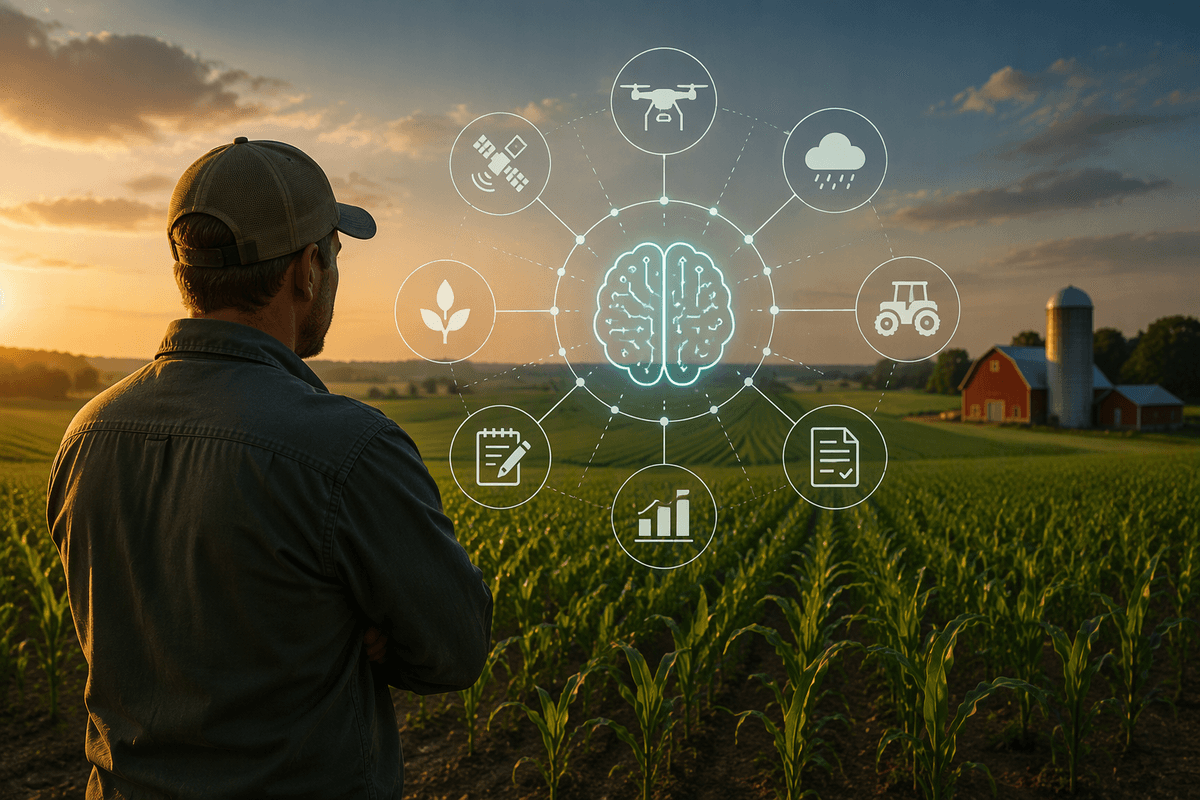
AI Meets a Fragmented Farm Data Reality
A grower may have yield maps from one platform, machine alerts from another, spray records in a contractor’s system, and field notes in a phone or notebook. AI can analyze patterns across those records, but only when it can reliably identify what happened, where it happened, and when. That is often the limiting condition—not the model itself.
A promising tool may predict disease risk, recommend variable-rate inputs, or flag equipment trouble in a demonstration. On an operating farm, however, missing field boundaries, inconsistent crop names, disconnected accounts, and files that cannot be exchanged can weaken or block the result. AI is most useful when it rests on connected, trustworthy records rather than trying to compensate for their absence.
Why Farm Data Is Harder Than It Looks
Two records can appear to describe the same field operation while meaning different things. One system may label a crop “corn,” another “grain maize,” and a third may carry last year’s name forward. Planting dates may reflect the day work began, the day it ended, or the day an entry was uploaded. A yield monitor can generate detailed data, yet its value falls quickly if its calibration, field boundary, moisture adjustment, or location signal is unclear.
Farm conditions add another layer of difficulty. Fields change through rotations, rented acres enter and leave the operation, equipment moves between farms, and weather creates local differences that broad regional data cannot explain. Records also come from people with different routines: an operator entering notes at the end of a long day, a retailer managing applications, and a consultant using separate software.
Cleaning and matching these details takes time, agreed definitions, and sometimes paid integration work. Without that effort, AI may produce a precise-looking answer built on mismatched evidence.
Useful Records Often Live in Separate Systems
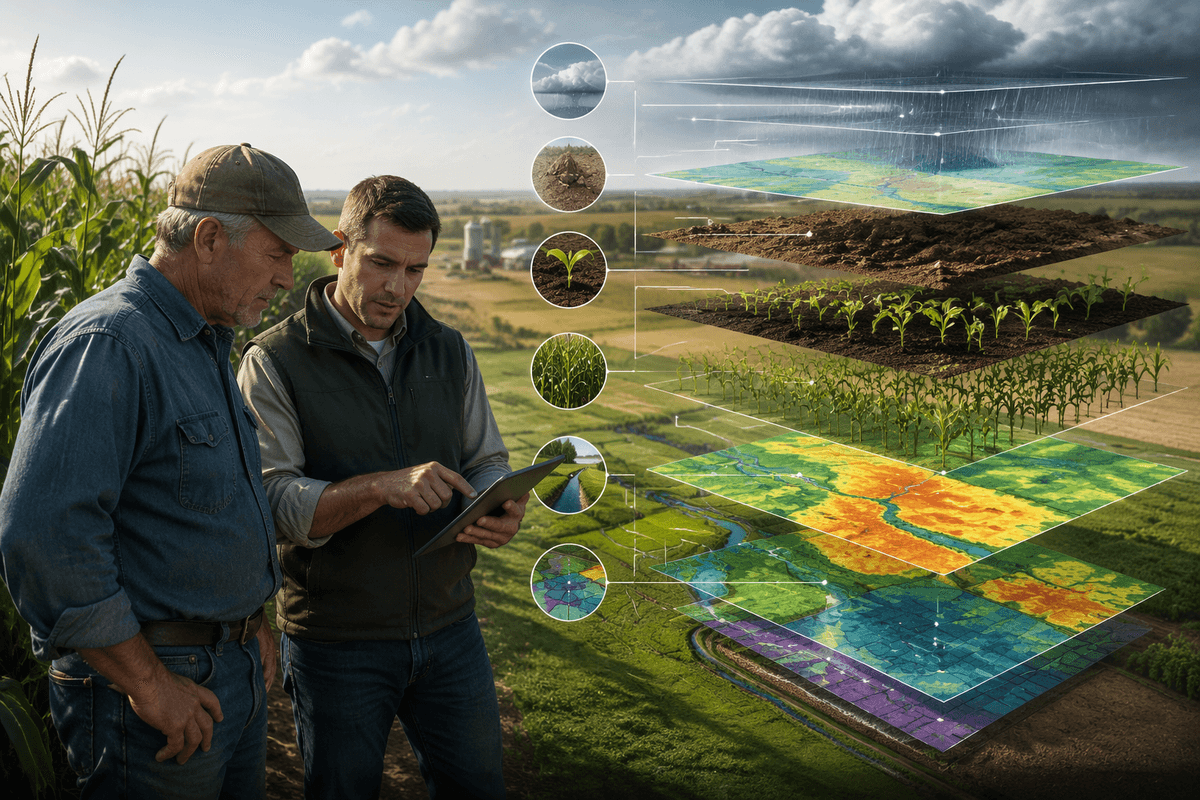
Consider a fertilizer decision after planting. The farm may hold soil-test results in an agronomy portal, application maps in a retailer’s account, equipment data in the manufacturer’s cloud, invoices in accounting software, and rainfall records from a weather service. Each record can be useful on its own. The difficulty is connecting them to the same field, season, crop, and management action.
This separation is not merely inconvenient. An AI tool asked to explain a weak area in a yield map may see the yield pattern but not the late planting, changed hybrid, drainage repair, or variable-rate application that helps explain it. It may also lack permission to retrieve records held by a contractor or supplier. Exporting files can help, but exports often arrive in different formats, with incomplete identifiers and no shared naming convention.
The practical goal is not to force every record into one large database. It is to establish reliable links among the few systems needed for a specific decision, while keeping field IDs, dates, units, and access rights consistent.
Volume Does Not Guarantee Decision-Ready Data
More data can make this problem harder rather than easier. A combine, planter, drone, weather station, and satellite service may produce millions of observations during a season. But a model cannot treat every point as equally useful. It needs to know whether a sensor was working, whether readings refer to the correct field and pass, and whether the measurement is comparable with earlier years. A dense yield map with uncorrected delays or bad GPS points can create apparent patterns that are really artifacts of collection.
Decision-ready data answers a defined question with enough context to judge its reliability. For a nitrogen recommendation, that may mean verified field boundaries, crop and planting details, soil results, prior applications, weather, and a clear record of units and timing. More imagery will not fix a missing application record. Nor will a larger historical dataset resolve a change in drainage, lease boundaries, or management practices. Can someone trace the recommendation back to the records and conditions that support it? If not, additional volume may raise storage and review costs without improving the decision.
Ownership and Trust Shape What Gets Shared

A farm operator may be willing to share a yield map with an adviser but hesitate to give a software provider ongoing access to machinery, input, and financial records. That hesitation is practical. The data can reveal production costs, land arrangements, operating practices, and business performance. Before connecting systems, growers need clear answers about who can view the records, how long access lasts, whether data can be reused to train products or sold in aggregated form, and what happens when a subscription or vendor relationship ends.
Unclear terms encourage partial sharing, delayed exports, or separate records kept outside the platform. That can leave an AI tool with only a narrow slice of the evidence needed for a recommendation. Trust also affects accuracy: people are less likely to correct mistakes or add useful notes when they do not know where that information will go.
Written data agreements, role-based access, export rights, and simple controls for revoking permission make cooperation more workable. They do not remove every concern, and negotiating them can take time, but they establish the confidence needed to connect records without surrendering control.
Start With Narrow Problems and Clean Inputs
A farm does not need to connect every data source before testing whether AI can help. A better starting point is a recurring decision with a clear cost: identifying fields that need scouting after a weather event, checking whether planned applications were completed, or prioritizing equipment alerts before a busy day. The question should be narrow enough that operators can state what information is required and what a useful answer would look like.
For example, a disease-risk tool may need accurate field boundaries, crop type, planting date, growth stage, and local weather—not years of loosely labeled imagery. Those inputs should be checked before the model is judged. Are field names stable? Are dates recorded consistently? Does the adviser have permission to see the relevant fields? A simple review can expose gaps that would otherwise appear later as questionable recommendations.
Small trials also make accountability practical. Compare the tool’s output with scouting observations and existing decisions, record where it was wrong or incomplete, and estimate whether the time saved exceeds subscription, integration, and staff costs. Once a narrow workflow produces reliable value, the farm has a sound basis for adding more records and more ambitious uses.
Build Data Habits Before Scaling AI
The most useful change may be a routine that feels unremarkable: confirm field identifiers when acres change, record applications when they occur, note unusual events such as replanting or drainage work, and correct obvious sensor errors before files are stored. These habits make records more comparable across people, seasons, and software. They also reduce the time spent later explaining why a recommendation does not fit what happened in the field.
Assign someone to maintain core field records, define a short list of required entries, and review data quality at practical points during the season. This adds work, and smaller operations may not have dedicated staff, so the process must stay proportionate to the decisions it supports. Scale AI only after those routines consistently produce records that people can trust, retrieve, and interpret.