When Machines Join the Mathematical Conversation
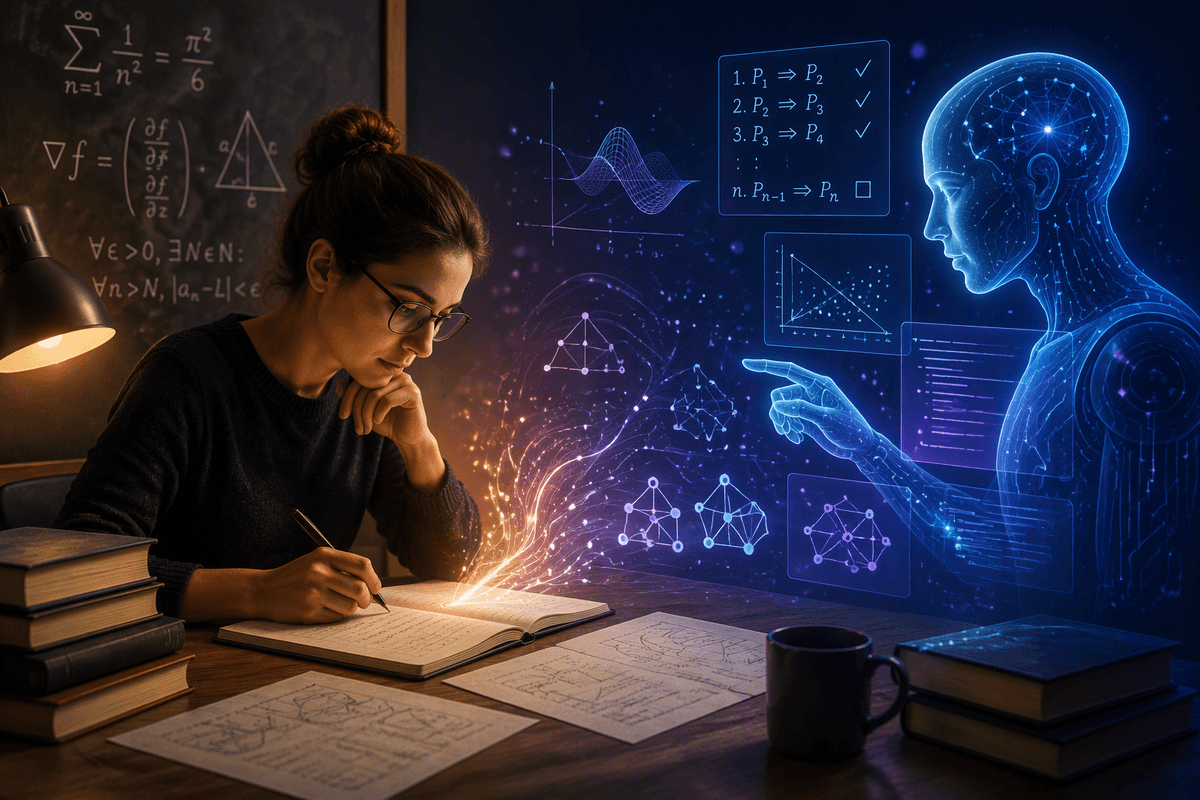
A mathematician working with a machine may begin with a familiar scene: a program tests thousands of cases and reveals a pattern that would be difficult to notice by hand. The machine has not yet discovered a theorem, but it has changed what deserves attention. It can compare examples, search large spaces, and suggest relationships that guide human intuition.
That distinction matters. A numerical pattern is an observation; a conjecture is a precise claim proposed for further testing; a proof is a logically complete argument that establishes the claim under stated assumptions. Machine learning can help generate the first two, sometimes with striking originality, but its suggestions may reflect gaps in the data or misleading regularities. The mathematician still has to ask why the pattern holds, whether it survives unusual cases, and what reasoning can verify it.
What Makes a Mathematical Collaborator Useful?
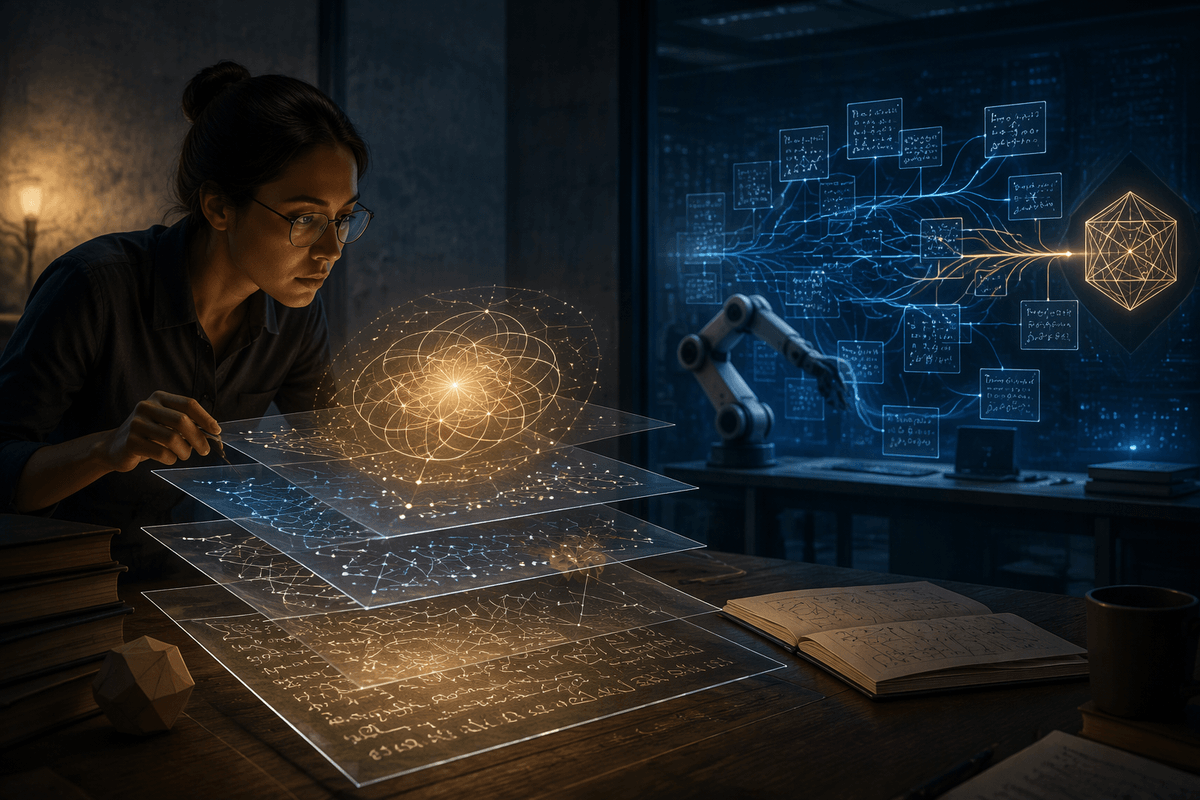
A useful mathematical collaborator does more than produce answers quickly. It helps a researcher decide which questions are worth pursuing. For example, a system might scan a database of graphs, equations, or number sequences and identify a relationship that appears repeatedly. Its value lies not only in reporting the pattern, but in ranking promising leads, finding counterexamples, and showing which assumptions seem to matter.
That usefulness depends on several practical qualities. The system should expose enough of its evidence for a mathematician to inspect the examples behind a suggestion. It should also distinguish a strong empirical regularity from a claim supported by logical reasoning. A model that confidently presents an unsupported formula may create more work than it saves, especially when its training data or search space is narrow. Human judgment remains essential for choosing definitions, recognizing meaningful structure, and deciding whether a conjecture expresses a genuinely new idea. The best collaboration therefore combines machine scale with mathematical standards: patterns can guide attention, conjectures can focus investigation, but only proof can establish certainty.
From Numerical Patterns to New Conjectures
Suppose a program examining prime numbers notices that a certain quantity appears unusually small whenever the primes fall into a particular arrangement. That observation becomes useful only after a mathematician turns it into a precise question: Does the relationship hold for every case, or only for the examples the program examined? The machine can extend the search, vary the parameters, and identify exceptions faster than a person working manually. It can also suggest several formulations of the same apparent rule, helping reveal which version is mathematically meaningful.
The step from pattern to conjecture requires more than matching data. A conjecture must define its terms, state its conditions, and survive deliberate attempts to break it. Models may propose elegant-looking relationships because they have detected correlations, not because they understand the structure producing them. Testing more examples increases confidence but never replaces an argument covering all permitted cases. A promising workflow treats machine output as a map of possibilities. Mathematicians inspect the evidence, search for counterexamples, connect the pattern to existing theory, and reshape it into a claim that can eventually be proved—or shown to be false.
The Proof Still Needs Human Scrutiny

A machine-generated proof can look persuasive while hiding a gap in its reasoning. It may rely on an unstated assumption, apply a rule outside the conditions where it is valid, or verify only the examples included in its search. Even formal-looking notation does not guarantee that every step follows from the definitions. A mathematician therefore checks the argument line by line, tests its edge cases, and asks whether the conclusion actually matches the original claim.
Formal verification can strengthen this process by translating an argument into a proof assistant that checks each permitted inference. That reduces the risk of overlooked logical errors, but it does not remove the need for judgment. Someone must still decide whether the formalized statement captures the intended idea, whether the chosen definitions are appropriate, and whether the result connects to a meaningful problem. Verification also has costs: preparing a proof for a formal system can take substantial time, particularly when the necessary concepts or libraries are not already available. AI can help draft, search, and repair proofs, but trust comes from inspectable reasoning rather than confidence, fluency, or a high success rate on familiar examples.
Choosing Between Intuition, Code, and Models
Once a conjecture has survived initial scrutiny, the mathematician still has to choose the right tool for the next step. Intuition is often best for deciding which definitions, analogies, or examples might reveal the underlying structure. Code is better suited to repetitive testing, large searches, and systematic attempts to find counterexamples. A machine-learning model can be useful when the relevant possibilities are too numerous or poorly organized for simple rules, especially when it can rank patterns that deserve closer examination.
These tools answer different questions, so replacing one with another can distort the investigation. Code may confirm that a statement holds across millions of cases without explaining why. A model may suggest an unexpected connection but offer no reliable measure of whether it is mathematically significant. Human intuition can identify a fruitful direction, yet it is also vulnerable to attractive analogies and selective examples. Practical limits matter as well: computation requires time and resources, models depend on suitable data or representations, and formal reasoning may be slow to construct. A disciplined workflow assigns each task accordingly: intuition frames the question, computation tests its range, models expand the search, and proof determines what can be trusted.
Building a Reliable Human-Machine Workflow
A reliable workflow begins by separating exploration from validation. A mathematician might let a model propose patterns, use code to test them across broader cases, and record the definitions, parameters, and data behind each result. Promising observations then become explicit conjectures, with deliberate searches for counterexamples before anyone invests time in a proof. Keeping these stages distinct prevents a plausible output from gaining the status of an established fact simply because it appeared early in the process.
Documentation is part of the mathematics, not administrative overhead. Researchers need to know which examples a system examined, which cases it missed, how its suggestions changed after refinement, and whether independent methods produce the same result. Reproducible code and carefully stated assumptions make that trail easier to inspect. Even so, the process can be expensive: large searches require computing resources, and translating a useful conjecture into formal proof may take longer than discovering it. The practical standard is therefore not to trust the machine as an authority, but to give each output an appropriate label—pattern, conjecture, partial argument, or verified proof—and move it forward only when the evidence justifies the next step.
A New Role for Mathematical Expertise
When machines can search widely, detect patterns, and draft possible arguments, mathematical expertise shifts from performing every calculation to directing the investigation. Mathematicians become responsible for choosing worthwhile questions, designing useful representations, recognizing misleading regularities, and judging whether a result changes understanding rather than merely extending a data set. Their expertise becomes more visible, not less, because these decisions determine what the machine is asked to find and how its output is interpreted.
The central skill is therefore disciplined translation: turning machine-generated patterns into precise conjectures, and conjectures into arguments that others can inspect and verify. AI may expand the range of ideas a mathematician can explore, but it cannot by itself decide what counts as an explanation or a dependable theorem. The most realistic future is not automated mathematics without people, but mathematics in which human judgment sets the standards while machines widen the search.