From Fleeting Conversation to Searchable Record
Conversation is rich but temporary. In a meeting, people exchange proposals, qualifications, decisions, and informal context at a pace that makes complete manual notes difficult. An interview contains not only answers but also follow-up possibilities, changes in emphasis, and useful wording that may be hard to reconstruct later. A lecture can connect ideas across a long sequence, leaving a listener with an impression but few searchable handles. AI note-taking addresses this capture problem by turning speech into a written record.
Transcription gives users a working representation of what was said. Instead of choosing between listening closely and writing constantly, they can pay more attention while an automated system records the conversation. The resulting text can be searched, copied, reviewed, and connected to other notes. This changes note-taking from a real-time compression exercise into a two-stage process: preserve more of the conversation first, then decide what deserves emphasis.
The record is not a perfect replacement for attention. Speakers may overlap, use specialized language, change topics quickly, or rely on visual material that speech alone does not capture. A transcript can also preserve every digression without indicating which parts matter. Its value is therefore foundational rather than final. It creates recoverable working memory, while interpretation and prioritization remain necessary human tasks.
Across meetings, interviews, and lectures, the same shift appears: remembering no longer depends entirely on the notes produced during the event. The user can return to the source conversation when a detail becomes important. That possibility makes later questions more specific and reduces the pressure to predict, in the moment, which sentence will eventually matter.
Summaries and Actions After the Conversation
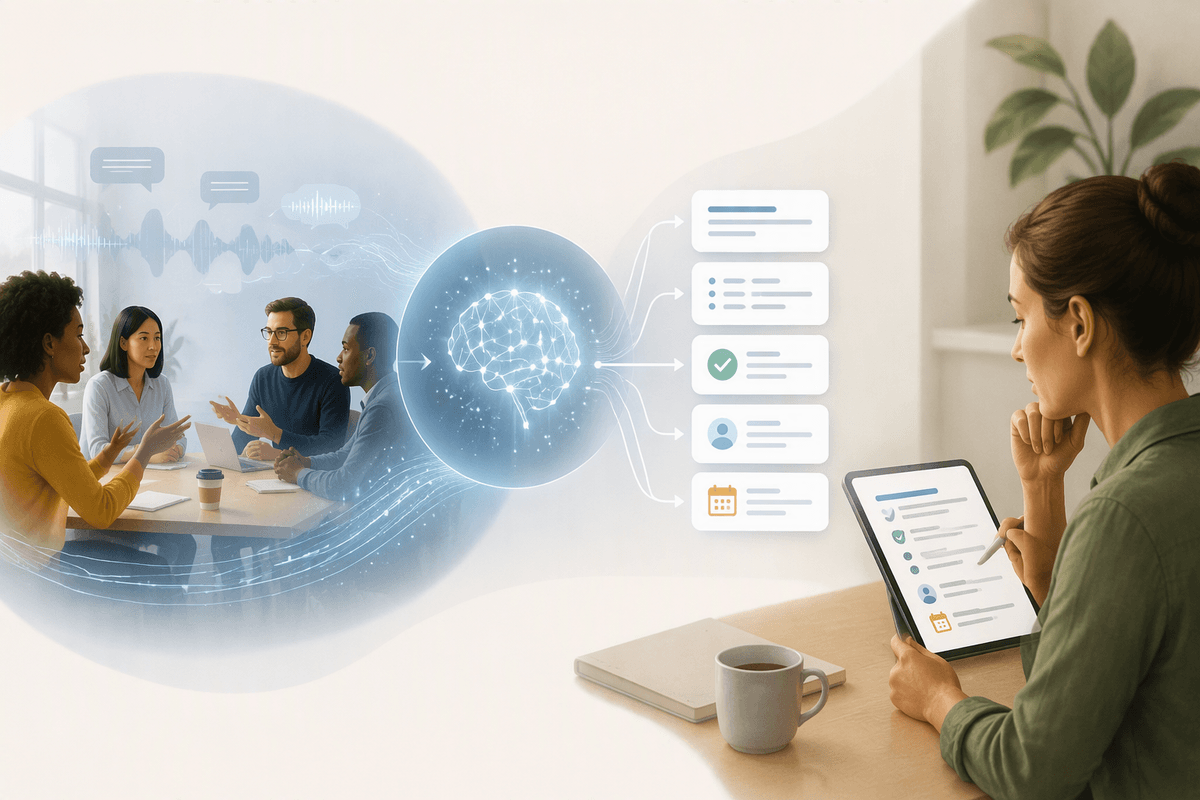
Once a conversation has been captured, AI can reshape it into forms designed for use. A summary may describe the central subject, major points, unresolved questions, and decisions. A meeting-oriented note can separate discussion from commitments. An interview note can group responses by theme. A lecture summary can organize concepts into a sequence that is easier to study. These transformations reduce the amount of text a person must revisit before taking the next step.
Action extraction is especially consequential. A long discussion may contain commitments in casual language: someone will send a document, confirm a requirement, schedule a conversation, or investigate an open issue. An AI note-taking system can surface possible tasks and associate them with a person, topic, or deadline when that information is present. The output becomes a bridge between conversation and execution rather than a passive transcript.
That bridge still needs review. A system may confuse a suggestion with a decision, assign an action to the wrong person, or interpret a tentative date as a firm commitment. The best workflow treats extracted actions as proposed items awaiting confirmation. A quick correction immediately after the conversation is usually more reliable than trying to reconstruct responsibilities days later.
Summaries also change what it means to attend. A participant can use the generated note to revisit the structure of a conversation and identify where their understanding differs from the record. In education, a learner can compare a concise explanation with the original material. In research or journalism, a summary can help prioritize which portions of an interview deserve closer reading. The gain is not merely shorter notes; it is a faster path from raw speech to deliberate follow-up.
Building a Usable Memory Across Notes
A single transcript is useful, but the larger promise of AI note-taking appears when many conversations become retrievable together. Search can answer practical questions such as when a proposal was discussed, which meeting introduced a requirement, or what a speaker said about a particular theme. Instead of relying on folder names or personal memory, the user can begin with the concept they remember and locate the relevant passage.
Retrieval works best when notes have consistent structure. A title can identify the event, while a date, participants, project, and status provide context. Sections for summary, decisions, questions, and actions make scanning easier. Tags or links can connect a meeting to a project brief, an interview to a draft, or a lecture to a study plan. AI can suggest this organization, but people should decide which categories are meaningful enough to maintain.
Searchable memory also changes preparation. Before a follow-up meeting, a user can review earlier decisions and unresolved questions rather than starting from a blank page. Before an interview, they can find previous references to a subject. During a project handoff, a structured history can explain not only the final choice but also the alternatives that were considered. Retrieval turns notes into accumulated context.
There is a danger of building an archive that nobody trusts. If every conversation is stored with inconsistent names, uncorrected errors, and no indication of confidence, search results may be plentiful but confusing. Organization should serve a recurring use case: finding decisions, checking commitments, learning from prior discussions, or tracing how a project evolved. A smaller, well-maintained memory is more useful than an indiscriminate warehouse.
Accuracy, Consent, and Privacy Boundaries
AI-generated notes are interpretations of a recording or audio stream, not an unquestionable account. Transcription can mishear names, numbers, accents, technical terms, or speakers. Summarization can omit a qualification or give equal weight to a passing remark and a formal decision. These errors are easy to miss because the resulting prose is often clear and confident.
Accuracy checks should focus on consequential material. Review names, figures, commitments, decisions, quotations, and statements that will be shared externally. If a transcript will support a report, publication, evaluation, or dispute, consult the original audio and distinguish direct wording from an AI paraphrase. A note can indicate uncertainty rather than hiding it. Labels such as “to confirm” or “possible action” help prevent a provisional interpretation from becoming institutional memory.
Privacy begins before recording. Participants should know when a conversation is being captured and how the resulting data will be used, stored, accessed, and shared. Sensitive meetings may contain personal information, confidential plans, research material, or privileged discussions that do not belong in a general note system. Organizations need clear boundaries for retention and access, while individuals should avoid treating convenience as automatic permission.
Privacy also continues after generation. A transcript may be more searchable than the original audio, which can increase both usefulness and exposure. Sharing a summary can unintentionally distribute details that were spoken only for a limited audience. Responsible note-taking therefore includes deleting unnecessary material, restricting access, correcting inaccuracies, and considering whether a full transcript is needed at all.
Designing a Better Follow-Up Habit
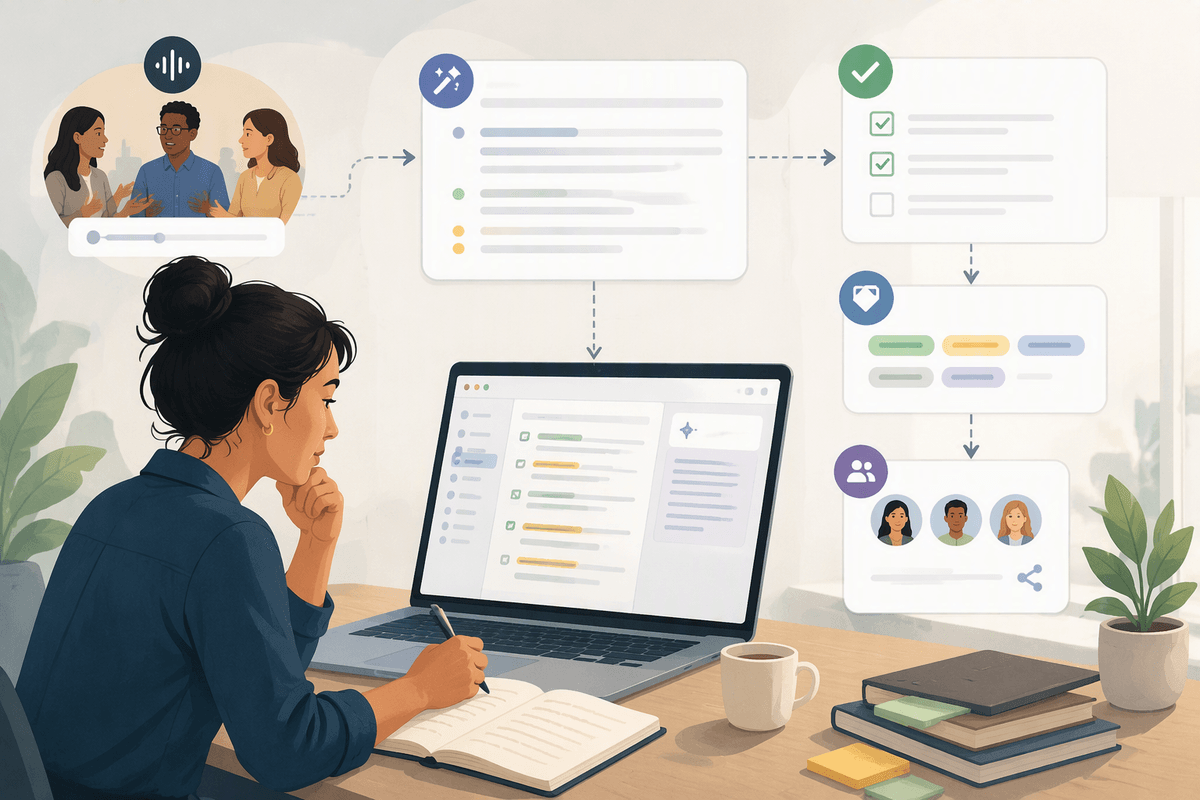
The strongest AI note-taking workflow is not fully automatic. It combines capture, review, organization, and action. Before an event, define what the notes are for: a decision record, a study aid, an interview reference, or a project handoff. That purpose helps determine whether a full transcript, a concise summary, or selected excerpts are appropriate.
Immediately afterward, review the generated output while the conversation is still familiar. Correct names and decisions, remove obvious noise, and confirm proposed actions with the people responsible. Add a short human-written context note when the transcript cannot explain why a choice mattered. This small investment turns machine output into a dependable working document.
Use predictable labels and links so future retrieval is easy. A consistent title pattern can include the event type, subject, and project. Separate confirmed decisions from open questions. Link related meetings and source materials. When sharing, choose the least detailed version that still serves the recipient, and mark summaries as summaries rather than implying that they are verbatim records.
Finally, treat searchable memory as a support for judgment. Ask it to locate context, compare prior discussions, and surface unfinished work, but decide for yourself what is accurate, relevant, and appropriate to retain. AI note-taking is most valuable when it frees attention during conversation and improves follow-up afterward. Its success is measured not by how much speech it stores, but by whether people can recover understanding and act on it reliably.