From Code Snippets to Development Workflows
AI coding assistants began as enhanced autocomplete, but modern development includes requirements, architecture, implementation, testing, review, release, and maintenance. The assistant now participates across these stages, helping developers explore possibilities, organize work, explain unfamiliar code, and prepare changes that remain subject to human review and acceptance.
A developer can describe an endpoint, provide an error, or identify a desired behavior. The assistant may suggest a plan, locate likely files, generate a starting implementation, and explain alternatives. This makes routine work faster while leaving design decisions with the team that understands the system and its users.
The most useful response is not necessarily a large block of code. It may be a diagnostic question, a warning about an edge case, a test outline, or a summary of a module. These small contributions reduce friction and help developers enter difficult tasks with a clearer sequence of questions.
Assistants can also make neglected work easier to begin. A migration note, bug reproduction, or review checklist can receive a first draft that exposes missing information. The draft is not evidence that the task is complete; it is a working surface that a developer can inspect, correct, and connect to project requirements.
They are also useful for comparing implementation paths before coding begins. A developer can ask for a simple approach, an approach consistent with an existing abstraction, and an approach that minimizes change. Reviewing those options helps expose tradeoffs and keeps the tool subordinate to deliberate engineering choices.
Successful use depends on existing practices. Clear conventions, tests, design notes, and review standards give suggestions useful boundaries. The assistant accelerates a development process, but it does not replace requirements analysis, technical judgment, or responsibility for the resulting software.
Generating Code Without Losing Understanding
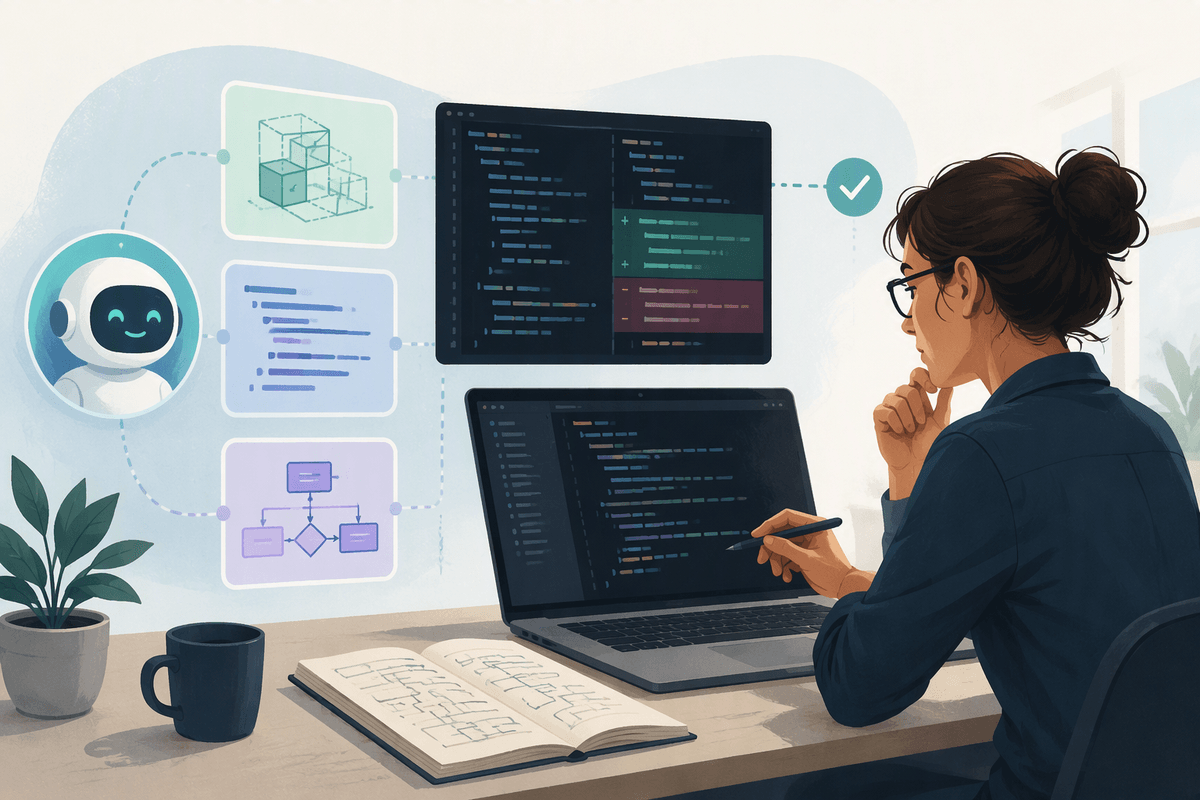
Generation works best when a change has a clear purpose and manageable scope. Developers can request a function skeleton, adapter, model, validation branch, or integration draft. They can compare the result with local conventions and treat it as a proposal that shortens the path toward a reviewable implementation.
Scaffolding reduces repetitive effort. An assistant can create a test structure, outline branches, or show how an established pattern might appear in the project language. Translation offers a similar benefit when developers compare equivalent expressions between languages or frameworks while retaining responsibility for behavior and compatibility.
Requesting alternatives before committing can clarify tradeoffs. A developer may ask for a readable approach, one matching an existing abstraction, and one minimizing change. Comparing them can reveal hidden assumptions and prevent the first fluent answer from becoming an accidental architectural decision.
Understanding cannot be delegated. Generated code may assume an input shape, use an unfamiliar library, mishandle an edge case, or ignore an existing contract. Developers must read every change, trace its data flow, consider boundary conditions, and ask why the implementation works before treating it as their own.
Small iterations are easier to inspect than a request to redesign an entire subsystem. Focused prompts, explicit constraints, and incremental reviews let developers reject weak approaches early, preserve local architectural knowledge, and keep changes understandable to colleagues who did not participate in the generation session.
Debugging, Testing, and Verification
Debugging is a natural collaboration point because developers can provide a symptom, trace, failing example, or expected behavior. An assistant may classify the failure, suggest inspection points, explain an unfamiliar error, and propose competing hypotheses. Its value often lies in making investigation more systematic.
A productive debugging exchange separates observation from speculation. The developer can ask what the evidence demonstrates, which assumptions remain untested, and what smallest experiment would distinguish possible causes. This keeps a confident guess from becoming the diagnosis before the code and behavior have been examined.
Generated fixes require evidence. A plausible change may silence one error while creating a different behavior elsewhere. Developers should reproduce the original failure, inspect the proposed path, run relevant checks, and test component boundaries. Compilation is useful, but it cannot prove that the intended behavior has been preserved.
Assistants can propose unit tests, validation cases, fixtures, and test data. They can also identify categories absent from an existing suite. The developer must decide whether each expected result reflects a real requirement and whether the test would fail for the defect being investigated.
Verification includes review, inspection, static analysis, and comparison with the original brief. Reviewers should ask what the change assumes, how it behaves with empty or unexpected inputs, and whether errors preserve surrounding contracts. An explanation from an assistant is not a substitute for executable evidence.
Documentation and Long-Term Maintenance
Much development happens after release. Assistants can turn implementation details into API notes, comments, migration guidance, and examples. They can summarize a module for a new contributor or compare documentation with visible behavior, reducing the friction of keeping supporting material close to the software.
The intended reader should be specified. An operator may need procedures and failure symptoms, while another developer may need interfaces, assumptions, and extension points. The assistant can produce a starting explanation, but an owner must check whether it is accurate, complete enough, and useful during the situation it describes.
Maintenance tasks often contain repetitive reasoning. A developer may rename an interface, update a call pattern, remove obsolete comments, or prepare a dependency migration. An assistant can locate likely references and propose edits, but compatibility requirements and every affected boundary still require deliberate human review.
Refactoring tests collaboration quality. An assistant may identify duplication or suggest a clearer structure, yet a locally elegant change can conflict with larger architecture. Before accepting a refactor, the team should define stable behavior, identify interfaces, and decide what evidence will demonstrate that those promises remain intact.
Documentation also needs an expiration check. Generated explanations can become misleading as code changes, while comments that merely repeat syntax quickly become stale. Treating documentation as maintained work, with owners and review points, prevents polished descriptions from drifting away from the system.
Architecture, Security, and Team Practice
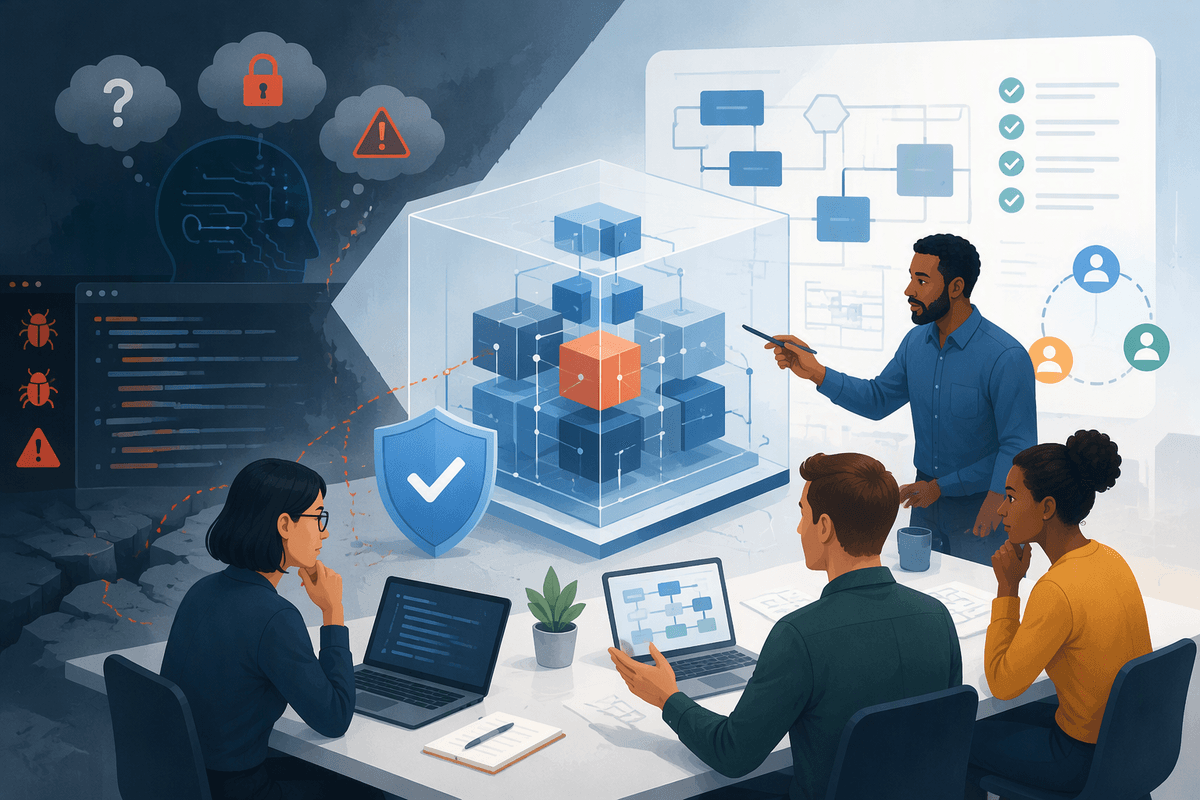
The largest risk is not that every suggestion is visibly wrong. A reasonable-looking change may conceal assumptions about trust, input handling, permissions, data flow, or failure behavior. Developers should inspect generated code for insecure defaults, excessive access, unsafe parsing, exposed secrets, and unnecessary dependencies.
Security review should begin with boundaries: what enters a component, who can invoke it, what it can change, and what happens when an external service fails. These questions expose risks that compilation cannot detect. Generated code should be evaluated against the project's threat model, not merely its apparent convenience.
Architectural drift is another concern. If every request is solved locally, a codebase can accumulate inconsistent patterns and duplicated responsibilities. Team conventions, design documents, and review ownership provide a counterweight. Reviewers should ask whether a change strengthens the system's overall shape.
Teams need rules for sensitive code and information, including what may be shared, which environments are appropriate, and when additional review is required. They can record recurring failure modes and useful prompting patterns so individual experiments become shared engineering knowledge rather than isolated habits.
Teams should periodically revisit those rules as repositories, dependencies, and delivery practices change. A clear owner can confirm whether an assistant still has appropriate access, whether review thresholds remain suitable, and whether lessons from rejected suggestions have been added to team guidance.
Accountability remains human. The developer submitting a generated change owns its behavior, and the reviewer evaluates it like any other contribution. AI coding assistants are most valuable when they handle routine exploration and expression while developers preserve understanding of requirements, architecture, security, and consequences.