Why Science Is a Natural Vibe-Coding Test
A researcher rarely begins with a blank page. They begin with a small friction point: cleaning a messy instrument export, testing a model against a dataset, plotting an unexpected result, or turning a repeated calculation into a usable tool. These are concrete tasks with inputs, assumptions, and visible outputs, which makes science a useful test for natural-language software building.
If a prompt can produce a working data pipeline, simulation interface, or analysis dashboard, the value is easy to inspect. But scientific work also exposes the limits quickly. A chart can look plausible while using the wrong units, leaking data, or hiding an invalid assumption. That tension makes the product more than a demo tool: it is a fast way to build around research, not a substitute for scientific judgment.
What the Product Actually Changes
The practical shift appears when a researcher stops translating every small idea into a ticket for a programmer or an afternoon of boilerplate. Instead, they can describe the desired workflow in plain language, inspect an initial application, and refine it through short cycles: add a CSV uploader, expose a parameter, compare two fitting methods, save the plot. The product reduces the cost of moving from an informal question to software that can be run and edited.
That is an interface and iteration change, not a change to the underlying science. It can assemble code, connect common components, explain choices, and make narrow internal tools accessible to people who would not normally build them. Yet it does not supply trustworthy data, select a defensible model, or establish that an output is reproducible. Generated code can also conceal dependencies, defaults, and errors that become costly later. Its credible role is to compress implementation time while leaving method design, review, and evidence with the people responsible for the result.
From Research Question to Working Prototype
Consider a materials scientist who wants to know whether a heat-treatment schedule changes a sample’s strength. The first useful prototype may be modest: a form for uploading measurements, controls for grouping samples and choosing an error model, and a chart that shows the relationship with the underlying data still visible. A natural-language build process can turn that description into something testable before the team commits to a larger software project.
The important work happens in the back-and-forth. The researcher notices that several samples lack temperature records, asks for those rows to be flagged rather than discarded, changes the plot to show individual observations, and adds an export containing the exact settings used. Each revision makes hidden decisions more explicit. The prototype can then become a shared object for discussion between domain experts, statisticians, and developers. It is not yet a validated research instrument: edge cases, data provenance, version control, access controls, and independent checks still take time. But it can reveal quickly whether the proposed workflow is worth formalizing.
Which Scientific Tasks Benefit Most First
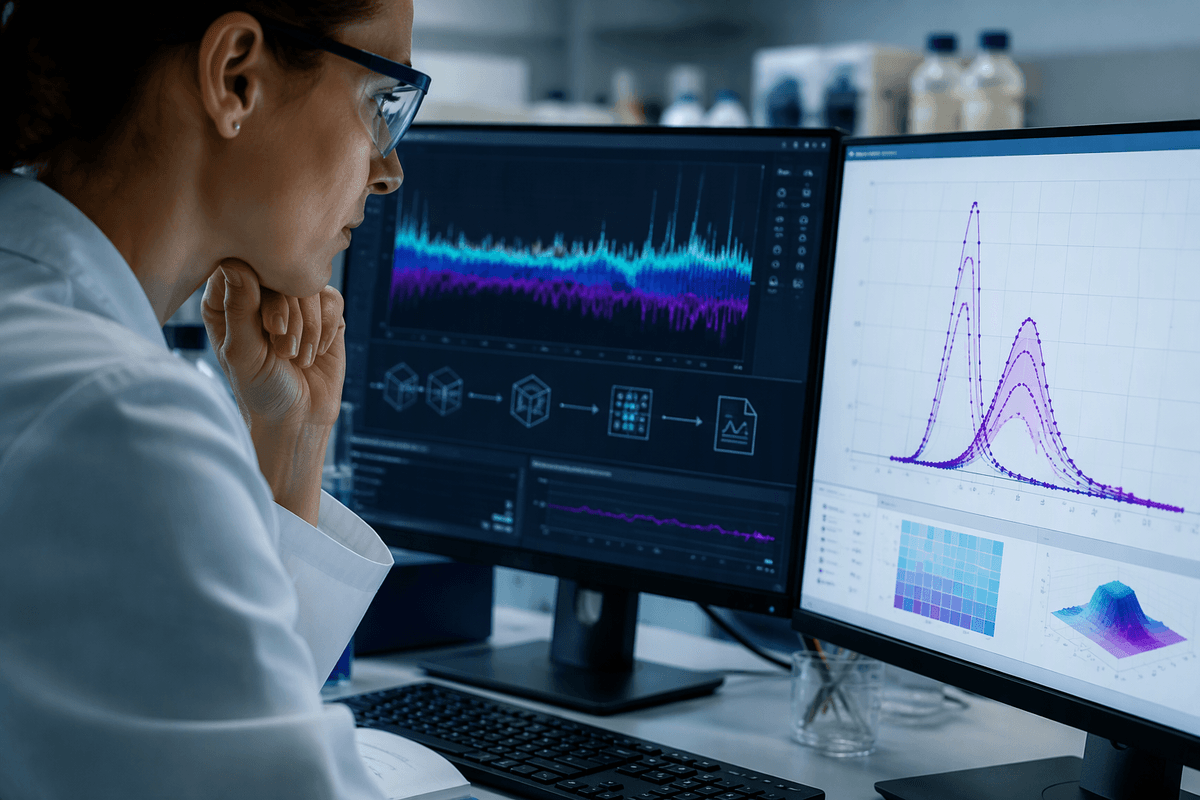
The earliest gains are likely to come from bounded, repetitive tasks where people can inspect the result against familiar expectations. Data cleaning tools, file-format converters, plotting interfaces, parameter sweeps, literature-triage helpers, and internal dashboards fit this pattern. A lab that repeatedly merges instrument exports, for example, may benefit more from a small purpose-built app than from another spreadsheet template passed between colleagues. The inputs are known, the desired transformations are visible, and errors can be caught by someone who understands the workflow.
Tasks become less suitable when the tool must make poorly defined scientific choices on its own. Selecting a causal model, interpreting an ambiguous image, deciding whether an outlier is an artifact, or recommending an experimental direction requires domain context that may not be captured in a prompt or dataset. Even seemingly simple automation can become fragile when formats change, metadata are incomplete, or a workflow expands beyond one team. The best first targets are therefore narrow but useful: work that consumes time, follows recognizable rules, and leaves a clear audit trail for human review.
Fast Results Still Need Scientific Validation
An app that produces a clean chart on its first run can create a misleading sense of completion. Before anyone relies on it, the team should test whether it handles known cases correctly: a dataset with a predictable answer, missing values placed deliberately, unit changes, duplicated records, and boundary conditions that could expose a faulty calculation. Comparing its output with a trusted script, hand calculation, or established analysis package is often more valuable than adding another feature.
Validation also has to cover the workflow around the code. Researchers need to know which data version was used, what prompts or edits changed the implementation, which library versions were installed, and whether another person can reproduce the result independently. A generated interface may make these details easier to overlook because it hides complexity behind convenient controls. That does not make the tool unsuitable; it changes the standard for using it. Treat early outputs as hypotheses about a useful workflow, then earn confidence through tests, documentation, review, and repeatable runs on real data.
How Teams Can Use It Responsibly

A responsible rollout usually starts with a workflow whose failure is inconvenient rather than consequential. A team might use the tool to prepare exploratory plots, standardize recurring files, or build an internal interface around an already reviewed analysis. One person should remain accountable for the method, while another checks representative outputs independently. That separation matters because a polished interface can make an untested calculation appear more settled than it is.
Teams also need simple operating rules: keep generated code in version control, record the data and settings behind important results, restrict access to sensitive datasets, and define when a prototype must move into a maintained codebase. A small app used by three lab members has different needs from one that informs a clinical, regulatory, or production decision. The cost of documentation and review can feel like it offsets the speed gain, but it prevents the faster build cycle from creating untraceable research debt. Use the product to shorten implementation, not to lower the evidence required for a conclusion.
Treat It as a Faster Lab Partner
Most researchers already use tools that accelerate part of the job: a plotting library, a statistical package, a notebook template, or a colleague who can turn a rough idea into code. This product fits best in that same category, but with a much shorter path from request to prototype. It can help make a workflow visible, testable, and easier to discuss before a team spends heavily on custom software.
Let it handle the first draft of the tool, not the final judgment about the science. Ask it to build narrow workflows, expose assumptions, and preserve outputs that others can inspect. Then apply the practices that make research trustworthy—domain review, comparison against known results, and versioned code and data. Used this way, it is not a replacement for expertise. It is a faster lab partner whose work still needs to be checked.