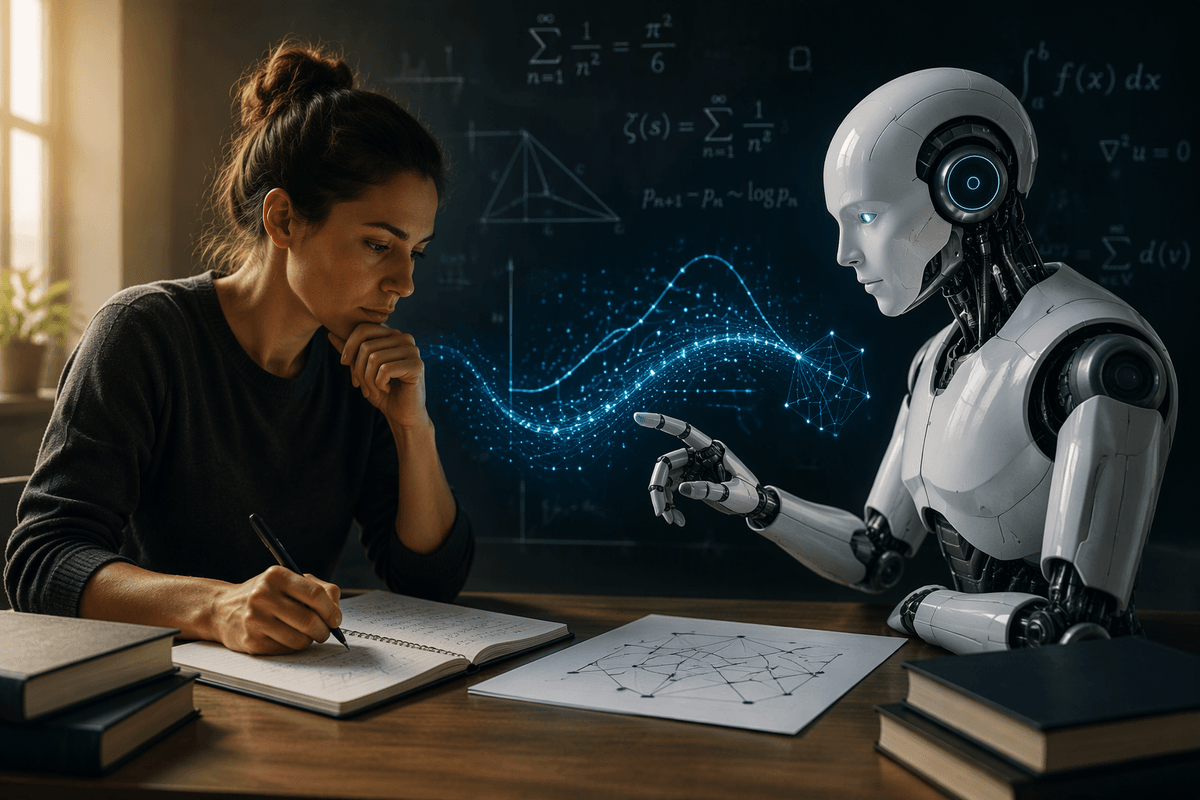
Can Machines Discover Physics Themselves?
Give a machine a table of measurements and it can often find a compact relationship hiding inside the noise. For example, it may infer that an object’s distance changes with the square of time, or that two quantities rise and fall together under controlled conditions. That is more than predicting the next measurement: the system is proposing a rule that links variables and can be tested on new cases.
Still, “discover” needs careful qualification. Algorithms search through mathematical possibilities selected by their designers, and they depend on useful measurements, sensible assumptions, and experiments that expose the relevant variables. A pattern can also fit existing data without describing a genuine law. Human scientists must therefore judge whether the relationship is robust, physically meaningful, and supported by independent tests. Machine discovery is best understood as accelerated scientific inference, not physics without guidance.
What Makes a Machine Scientist Different?

A conventional machine-learning model is usually judged by how accurately it predicts an outcome. A machine scientist faces a stricter test: it must identify a relationship that can be written down, interpreted, and checked against physical evidence. Instead of treating measurements as unrelated inputs, it searches for combinations of variables, rates of change, symmetries, or conserved quantities that might explain why the data behave as they do.
That search often uses symbolic regression or similar methods, which compare many candidate equations while rewarding simplicity and accuracy. The result is not automatically a law. A complicated formula may fit the measurements perfectly but fail on a new experiment, rely on meaningless variables, or hide an error in the data. The system also needs boundaries: researchers may specify units, plausible mathematical forms, known conservation rules, or which quantities can influence one another. Its distinctive role is therefore not independent reasoning in the human sense. It is the ability to explore a large space of testable explanations and return a small number of candidates that scientists can examine, reject, or refine.
From Messy Measurements to Hidden Equations
In practice, the process begins with measurements that are far less orderly than a textbook equation. Sensors may record noise, missing values, uneven time intervals, or several effects at once. A machine scientist first has to determine which quantities change together and which apparent relationships disappear when conditions change. It may calculate derivatives, compare different experimental runs, or transform variables so that a hidden structure becomes easier to detect.
The system then tests candidate equations against the observations, balancing two demands that often conflict: accuracy and simplicity. A formula with many adjustable terms can follow messy data closely, but it may be overfitted rather than explanatory. A shorter equation may miss important effects, especially when measurements cover only a narrow range. Researchers therefore examine whether the proposed relationship uses sensible units, survives noise and withheld data, and predicts results from a different experiment. The valuable output is not merely a close-fitting curve. It is a compact relationship whose terms correspond to measurable features and whose failures reveal where the current model, or the experiment itself, remains incomplete.
Why Raw Data Rarely Reveals Laws Directly

A table of observations does not arrive labeled with causes, relevant variables, or the conditions under which a relationship holds. The same measurement may reflect several processes at once: friction can obscure motion, temperature can alter a material’s response, and an instrument can introduce a bias that looks like a physical effect. Limited experiments create another problem. If data cover only a narrow range, many different equations may make nearly identical predictions, leaving no clear reason to prefer one as a law.
This is why discovery requires more than searching for correlations. The system must separate stable structure from coincidences produced by noise, sampling choices, or hidden variables. It may need repeated trials, carefully designed comparisons, and measurements of quantities that were not initially considered important. Even then, a short formula may be elegant but valid only under restricted conditions, while a more detailed model may better describe the mechanism. Machine scientists can expose promising relationships, but deciding whether those relationships represent laws still depends on experimental design, domain knowledge, and tests that deliberately challenge the proposed explanation.
Where These Systems Have Found Real Patterns
The clearest successes have come in settings where the important variables are measurable and the experiments can be repeated. Symbolic-regression systems have recovered familiar relationships in mechanics, such as equations linking position, velocity, and acceleration, sometimes from data that do not present those quantities in their usual textbook form. Other systems have identified conserved quantities in simulated physical systems, reconstructed governing equations for fluid motion, and inferred compact models of materials or biological processes from time-series measurements.
These examples matter because the systems are not simply labeling similar cases. A useful equation can predict how the system will behave under conditions that were not included in the training data, and its terms may suggest which measurements are physically important. Yet the achievement is usually narrower than headlines imply. Many demonstrations use simulated data, controlled laboratory setups, or equations drawn from a limited search space. Real instruments introduce noise, missing variables, and changing conditions that can defeat an apparently successful formula. The strongest evidence comes when a machine-generated relationship survives new experiments and helps researchers design better ones, rather than merely reproducing a pattern already built into the data.
Can Algorithms Explain What They Discover?
A machine-generated equation can be easy to write down and still difficult to explain. Its symbols may correspond to measured quantities, but that does not prove the system has identified the mechanism connecting them. A formula might predict a planet’s motion accurately while offering no account of gravity, or combine several variables in a way that works only because they happened to vary together in the available data. Explanation requires more than compact notation: scientists must ask why these variables appear, whether the relationship follows known principles, and what new observation would distinguish it from competing accounts.
Interpretability tools can help by showing which terms matter, how predictions change when inputs are varied, and where the equation fails. Researchers can then use those failures to design experiments that isolate missing effects or test unusual conditions. Demanding human-readable formulas can exclude useful relationships that are too complex to express simply, while allowing unrestricted models can produce accurate but opaque predictions. Algorithms therefore contribute candidate explanations, not finished theories. Their scientific value depends on whether people can connect the proposed relationship to measurements, mechanisms, and experiments that could prove it wrong.
A New Partner for Scientific Discovery
In a working laboratory, a machine scientist is most useful when it changes what researchers do next. It can sift through thousands of candidate relationships, flag an unexpected combination of variables, or identify measurements that would separate competing explanations. Scientists still choose the questions, build or improve the experiments, and decide whether a result matters. The partnership is practical: algorithms expand the search, while human judgment supplies context, skepticism, and physical meaning.
That arrangement also sets a realistic standard for success. A discovered equation should be simple enough to inspect, robust under new conditions, and useful for planning further tests—not merely accurate on archived data. Computing power, data quality, and the chosen search space limit what the system can find, and important discoveries may remain hidden if researchers measure the wrong quantities. Machine scientists are therefore not replacements for theorists or experimentalists. They are new instruments for turning observations into sharper, more testable questions.