A Strange Pattern Emerges From Elliptic Curves
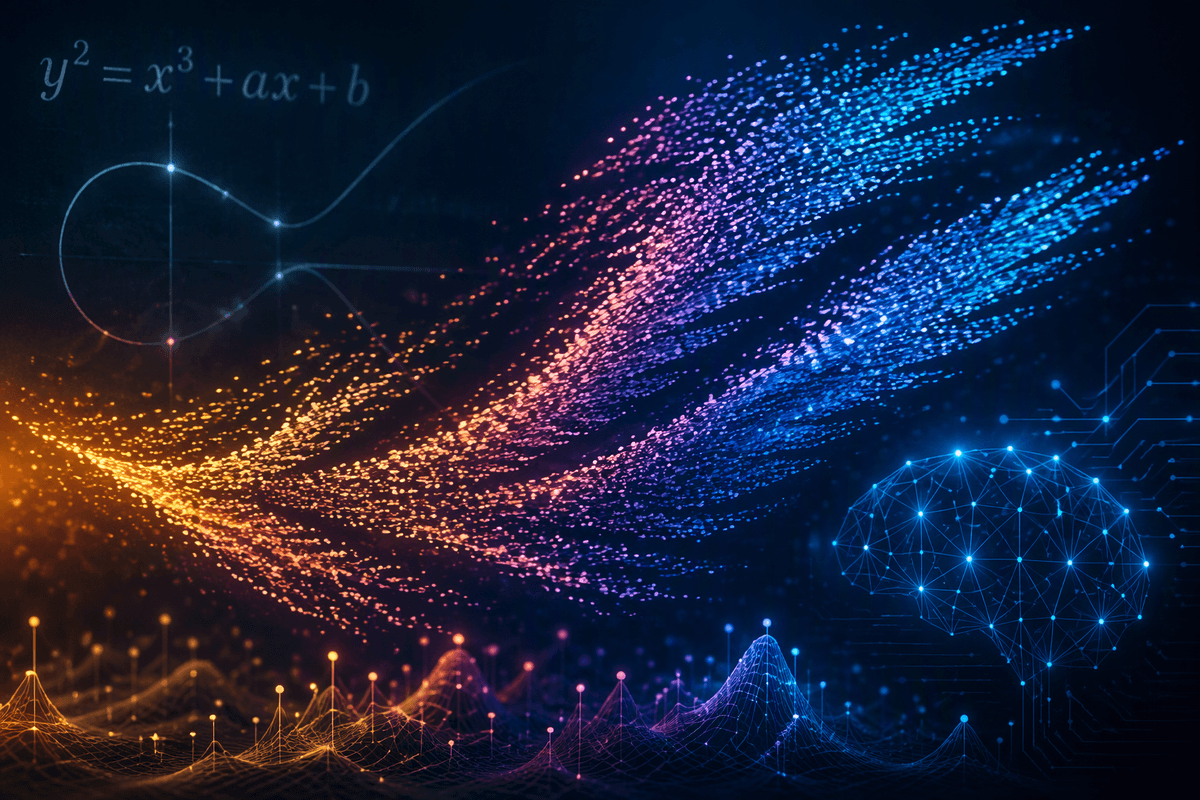
Elliptic curves usually enter mathematics as equations, not pictures. Yet when researchers arranged large collections of these curves according to carefully chosen numerical features, an unexpected image began to form: broad, winglike bands of points, with gaps and dense regions that resembled a flock of birds turning together. The resemblance led to the nickname “murmuration.”
The striking part was not simply that the plots looked attractive. Similar shapes appeared in data drawn from different families of elliptic curves, suggesting that the arrangement was not random noise or a coincidence in one experiment. Researchers could see the pattern before they understood its source. That gap—between a visible regularity and a mathematical explanation—made the discovery both intriguing and difficult to interpret.
Why Elliptic Curves Generate So Much Data
The raw material for these images comes from a simple mathematical habit: study the same kind of equation many times while changing its coefficients. An elliptic curve can be written in a form such as y2 = x3 + ax + b, where different choices of a and b produce different curves. Researchers can then record properties of each curve, including how many solutions it has modulo different prime numbers.
Each prime gives another numerical measurement, so even a modest collection of curves quickly becomes a large table. The measurements are not arbitrary. They reflect how the curve behaves when viewed through different modular “lenses,” and number theory predicts relationships among some of those observations. To make the data visible, researchers place curves in rows or groups and use their recorded values as coordinates, colors, or intensities.
That process creates millions of possible comparisons, but it also introduces practical difficulties. The picture can change if researchers choose different features, scales, or subsets of curves. A recurring shape is therefore worth investigating, but it still has to survive careful checks against artifacts created by the way the data was organized.
The “Murmuration” Appears Across the Numbers
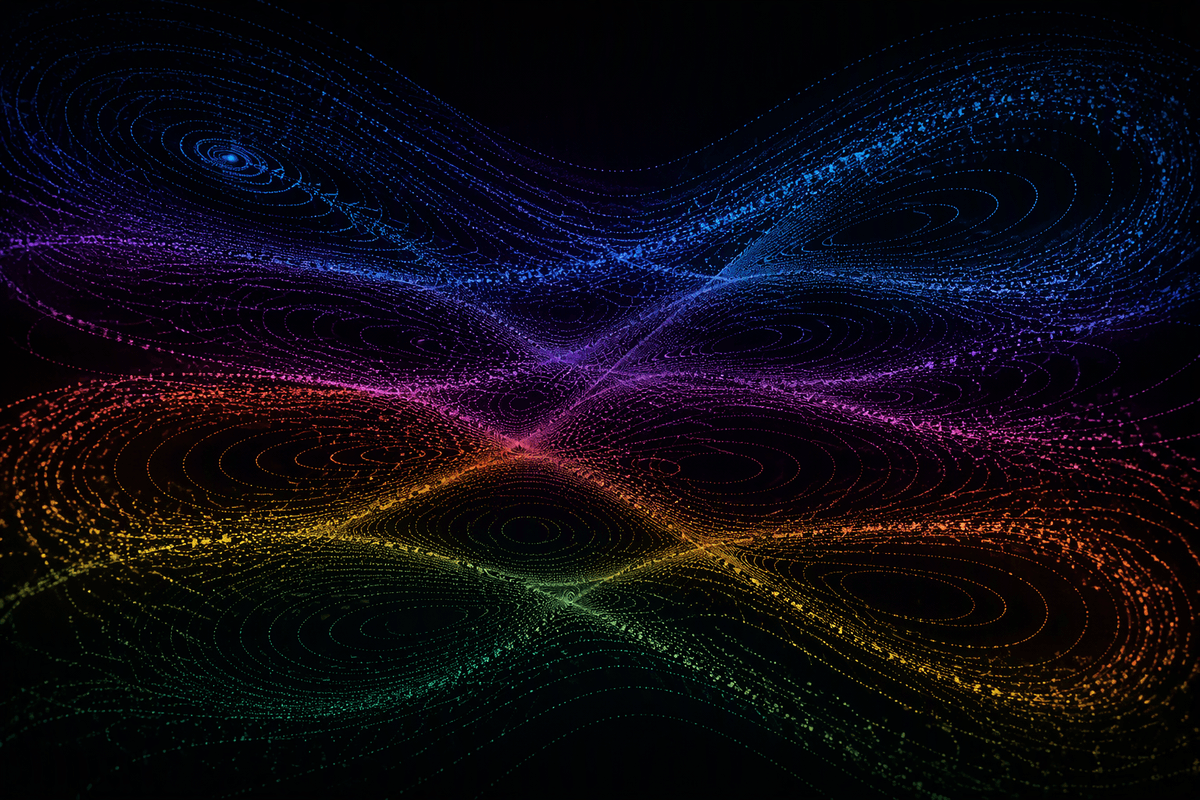
When the measurements were plotted together, the data did not spread evenly across the graph. Instead, points gathered into sweeping bands that bent and shifted in a coordinated way. Some regions were densely populated, while neighboring areas remained comparatively empty. Viewed as a sequence of plots, the bands seemed to move like a flock changing direction, giving the pattern its name.
The resemblance became more compelling when researchers repeated the experiment with different collections of elliptic curves and different numerical summaries. The exact image could vary, but related structures continued to appear. This suggested that the effect was connected to the arithmetic of the curves rather than to one unusual dataset. The plots also revealed details that would be difficult to notice by reading tables of values: symmetry, alignment, and gradual changes across groups of curves.
Still, a visual pattern can mislead. Choices about which curves to include, how to scale the axes, and how to color the points may strengthen or weaken an apparent shape. The important question was whether the murmuration survived those choices—and whether a method could detect its structure more reliably than human eyes alone.
What Artificial Intelligence Added to the Search
Artificial intelligence helped by treating the plots as data rather than as pictures judged only by human attention. Researchers could feed numerical descriptions of elliptic curves into machine-learning methods and ask whether curves with similar hidden properties tended to occupy similar positions. These methods are useful when relationships involve many variables at once, including values measured at several primes. Instead of testing one suspected connection after another, an algorithm can scan broad combinations and highlight groups that behave alike.
AI also provided a way to compare images or data sets systematically. If a murmuration appeared in one collection, researchers could test whether related arrangements occurred elsewhere, even when the scale or exact shape differed. That does not mean the computer independently “understood” the mathematics. It identified recurring structure and suggested which measurements deserved closer examination. Human researchers still had to decide whether the result reflected genuine arithmetic or an artifact of the data pipeline.
A person might notice one striking plot; an algorithm can examine thousands of alternatives. Its weakness is equally important: machine-learning systems can find patterns in biased, incomplete, or poorly organized data, so their discoveries require mathematical verification.
Matching the Pattern to Hidden Mathematical Structure
The next step was to compare the visual bands with quantities already known to encode deep information about elliptic curves. One important candidate was the curve’s L-function, a mathematical object built from its behavior modulo many primes. In related settings, L-functions connect elliptic curves with modular forms—different-looking objects that can nevertheless carry the same arithmetic information. If curves with similar hidden data produced similar points in a plot, the murmuration might be a visible trace of that connection.
Researchers also examined features such as the curves’ ranks, conductors, and local point counts. These measurements are not independent labels. They are linked by equations, symmetries, and conjectures about how elliptic curves are distributed. The patterns suggested that the plotted data was responding to combinations of these properties rather than to any single number. AI helped identify the combinations; number theory supplied possible reasons they might matter.
A match between a picture and a known mathematical structure is evidence of a relationship, not a complete proof of its cause. The same pattern may reflect several overlapping constraints, and distinguishing them requires exact calculations rather than visual similarity alone.
Discovery Is Not the Same as Explanation
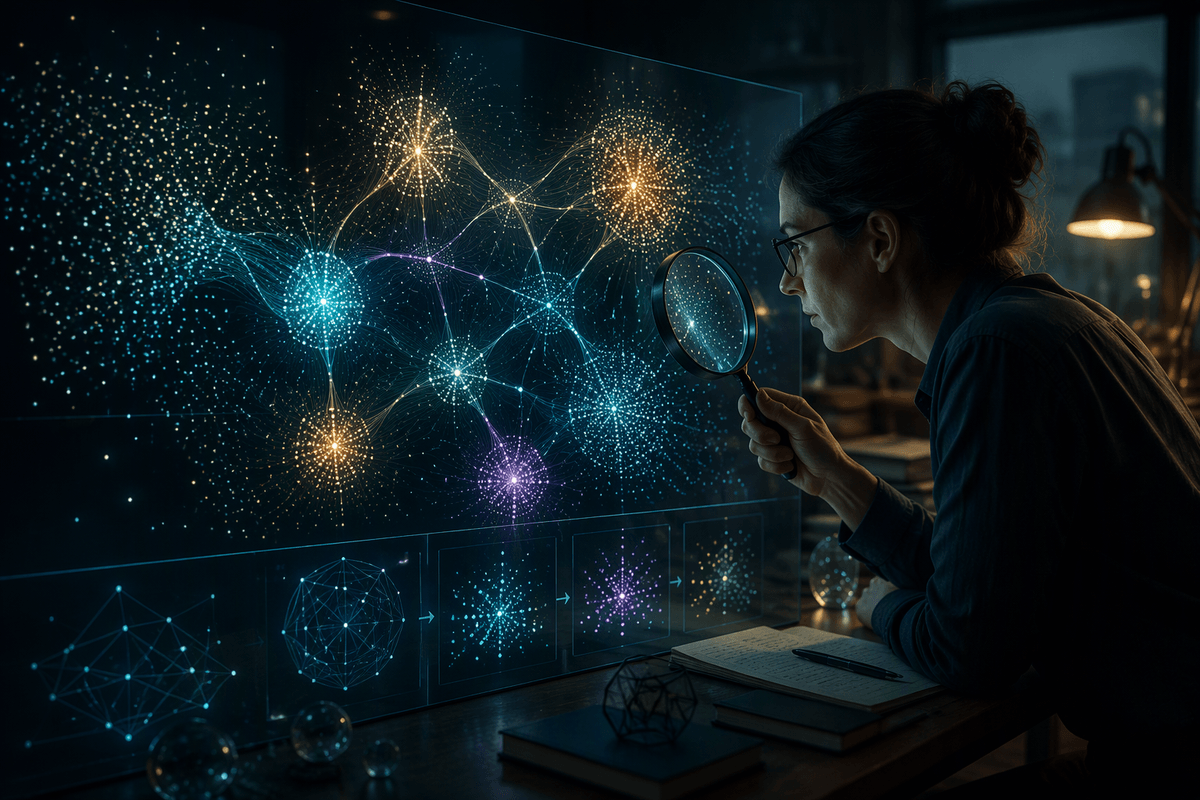
A compelling plot can show that elliptic curves are related, but it cannot by itself say why. The bands may arise because several arithmetic quantities are constrained by the same underlying structure, because the data was sampled in a particular way, or because the chosen coordinates emphasize an existing correlation. Even a pattern that survives changes in color and scale may still leave open which mathematical mechanism produces it.
That distinction matters when interpreting AI-assisted discoveries. A machine-learning model can separate curves into groups, predict missing values, or identify combinations of measurements that reproduce the murmuration. Those results make useful conjectures, but they do not replace a proof. Researchers must test the proposed relationship on new families of curves, derive it from established theory, and determine whether it holds beyond the examples used to find it. This work is slower than generating a striking image, and some apparent connections may weaken or disappear under stricter tests.
The murmuration is therefore best viewed as a signpost. It points toward hidden links among elliptic curves, modular forms, and their associated L-functions, while leaving the precise explanation to mathematics still being developed.
A New Way to Notice Mathematical Connections
For readers, the lasting lesson is not that every attractive graph hides a revolutionary theorem. It is that visualization can expose relationships that are difficult to see in formulas or tables. Elliptic curves supply the data, AI helps search its many dimensions, and mathematical theory tests whether the resulting pattern reflects something real. Each tool contributes a different kind of evidence.
This approach also changes how connections are found. A researcher can begin with an unexpected image, use computation to ask sharper questions, and then return to exact mathematics for confirmation. The murmuration is valuable even before its full explanation is known: it offers a shared clue that may guide future work while preserving the essential distinction between noticing a pattern and proving what it means.